
Description
DESCRIPTION
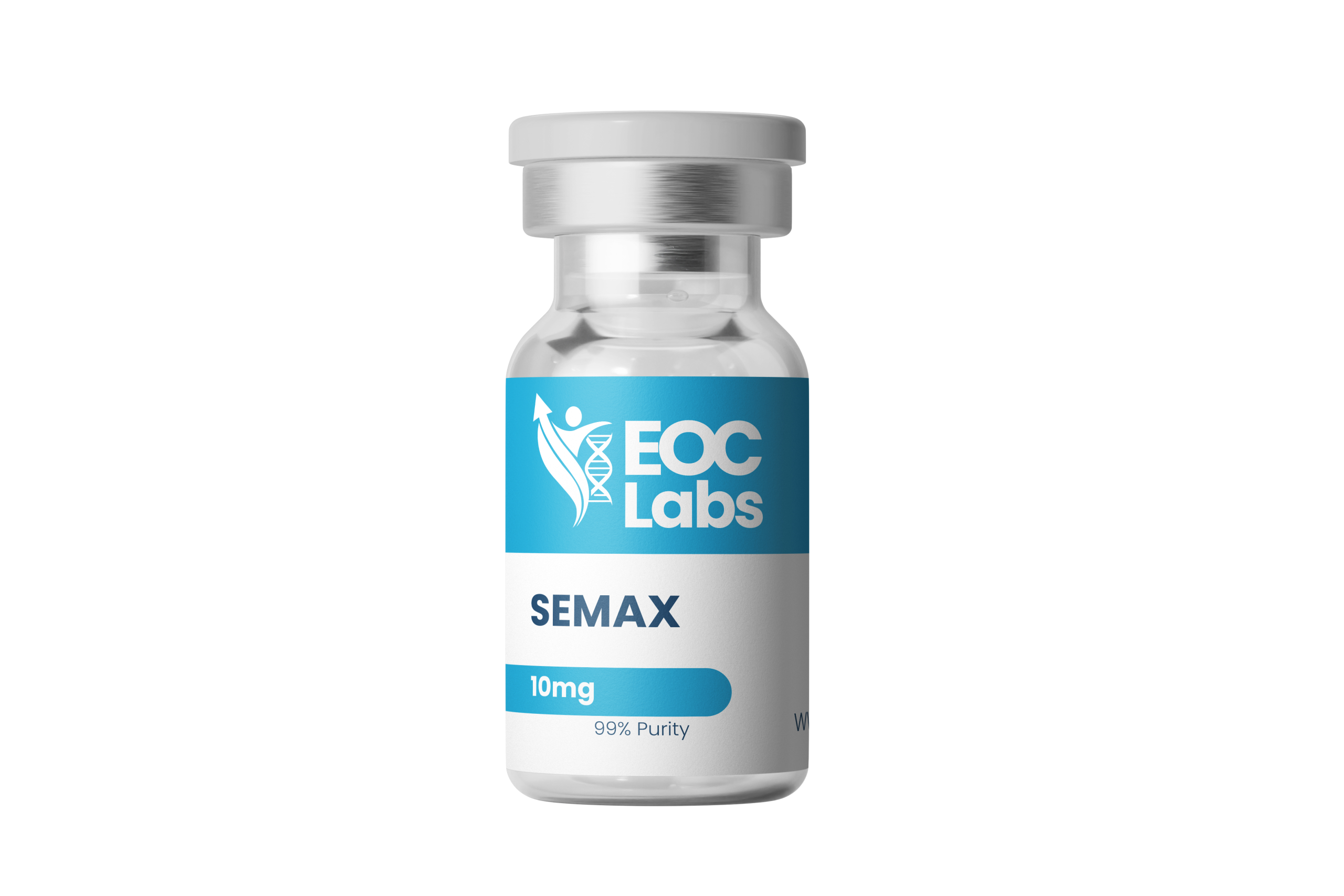
SEMAX is a synthetic heptapeptide (Met-Glu-His-Phe-Pro-Gly-Pro), derived from the ACTH(4–10) fragment, and widely studied for its roles in cognitive processes, neurotrophic modulation, neuroprotection, oxidative-stress regulation, and cerebral signaling pathways. Research models explore its influence on BDNF expression, synaptic plasticity, attention mechanisms, memory formation, and neuroendocrine stress-response systems. SEMAX is frequently used in controlled laboratory settings to investigate central nervous system adaptation and neurochemical regulatory functions.
LYOPHILIZED PEPTIDES
This peptide is supplied as a sterile, freeze‑dried (lyophilized) powder to maintain molecular stability, purity, and long‑term integrity. No fillers, carriers, or excipients are added during the lyophilization process.
RESEARCH APPLICATIONS
1 — Cognitive Enhancement & Memory Pathway Research
SEMAX has been evaluated for its effects on synaptic transmission, attention circuits, and memory‑related neuroplasticity. Research also explores its influence on BDNF expression and monoaminergic neurotransmission.
(References: PubMed—https://pubmed.ncbi.nlm.nih.gov/21605582/, PubMed—https://pubmed.ncbi.nlm.nih.gov/15862918/, ScienceDirect—https://www.sciencedirect.com/science/article/pii/S0166432816305516 )
2 — Neuroprotection & Oxidative‑Stress Modulation
Laboratory models indicate SEMAX may support neuronal resilience through antioxidant‑enzyme regulation, anti‑inflammatory signaling, and attenuation of oxidative damage in stressed neural tissues.
(References: PubMed—https://pubmed.ncbi.nlm.nih.gov/16181260/, PubMed—https://pubmed.ncbi.nlm.nih.gov/23113316/, Frontiers—https://www.frontiersin.org/articles/10.3389/fnins.2019.01129/full )
3 — Ischemic Injury & Stroke‑Recovery Modeling
SEMAX has been studied in controlled ischemic models for impacts on cerebral perfusion, neurofunctional recovery, neural stabilization, and adaptive responses following hypoxic injury.
(References: PubMed—https://pubmed.ncbi.nlm.nih.gov/12796686/, PubMed—https://pubmed.ncbi.nlm.nih.gov/15932605/, Nature—https://www.nature.com/articles/s41598-017-12189-1 )
4 — Stress‑Response, Mood Pathways & Neuroendocrine Regulation
Research investigates SEMAX’s effects on stress‑adaptation pathways, neuroendocrine signaling, and neurotransmitter balance, including its influence on behavioral‑stress markers and emotional‑regulation circuits.
(References: PubMed—https://pubmed.ncbi.nlm.nih.gov/18037588/, PubMed—https://pubmed.ncbi.nlm.nih.gov/20412448/, MDPI—https://www.mdpi.com/2076-3425/11/8/1030 )
SPECIFICATIONS
Property | Details
Peptide Name | SEMAX
Amino Acid Sequence | Met‑Glu‑His‑Phe‑Pro‑Gly‑Pro (MEHFPGP)
Chemical Name | L‑methionyl‑L‑glutamyl‑L‑histidyl‑L‑phenylalanyl‑L‑prolyl‑glycyl‑L‑proline
CAS Number | 80714‑61‑0
Molecular Formula | C37H51N9O10
Molecular Weight | ~751.85 g/mol
Purity | ≥ 99% (HPLC verified)
Appearance | White to off‑white lyophilized powder
Solubility | Soluble in sterile/bacteriostatic water
Storage | Store dry at −20 °C; refrigerate after reconstitution
Usage | Laboratory research only
Research Data & References
– Cognitive signaling & BDNF modulation: https://pubmed.ncbi.nlm.nih.gov/21605582/
– Neuroprotection & oxidative‑stress research: https://pubmed.ncbi.nlm.nih.gov/23113316/
– Ischemic injury & cerebral recovery: https://pubmed.ncbi.nlm.nih.gov/15932605/
Research Disclaimer
RESEARCH USE ONLY.
This product is not intended for therapeutic or diagnostic use. EOC Labs products are sold strictly for laboratory research and analytical purposes only. All information provided by EOC Labs, including descriptions, references, and technical data, is intended solely for educational and informational purposes. Statements have not been evaluated by the U.S. Food and Drug Administration (FDA). No claims are made for any medical or consumer application. By purchasing this product, the buyer certifies that it will be handled by qualified professionals in a properly equipped laboratory and used in compliance with all applicable local, state, and federal laws and regulations.

 20% off (first time buyer sign up).
There are no reviews yet.