


Description
DESCRIPTION
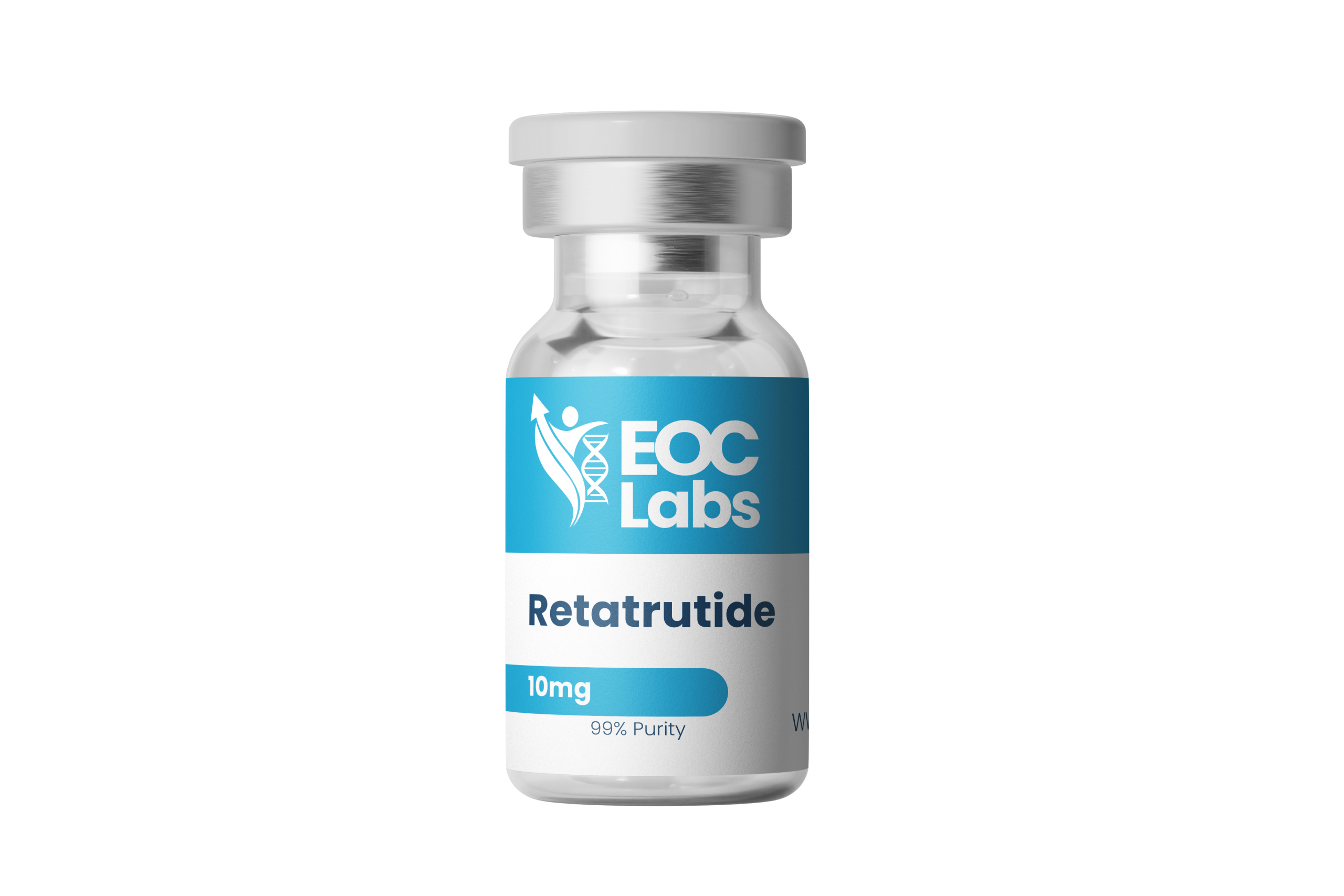
Retatrutide (LY3437943) is an investigational long‑acting peptide studied as a triple agonist at the GLP‑1, GIP, and glucagon receptors. Its multi‑receptor activity is being explored in metabolic research models focusing on glucose homeostasis, adiposity regulation, energy expenditure, hepatic signaling, and cardiometabolic function. Preclinical and early‑phase studies evaluate its biochemical influence across appetite modulation pathways, insulin sensitivity, and whole‑body energy balance.
LYOPHILIZED PEPTIDES
This peptide is provided in lyophilized powder form to preserve purity, structural stability, and long‑term molecular integrity. No fillers or excipients are used in the freeze‑drying process.
RESEARCH APPLICATIONS
1 — Obesity & Weight‑Regulation Mechanisms
Retatrutide is studied for its multi‑agonist influence on appetite signaling, thermogenic pathways, and body‑weight modulation. Researchers investigate its effects on GLP‑1/GIP synergy and glucagon‑mediated energy expenditure.
(References: Nature—https://www.nature.com/articles/s41591-023-02590-2, PubMed—https://pubmed.ncbi.nlm.nih.gov/37365087/ )
2 — Type 2 Diabetes & Glycemic Research
Preclinical and clinical models assess Retatrutide’s impact on glucose control, insulin signaling, pancreatic islet responsiveness, and glycemic stability. Its multi‑receptor activation offers a broad mechanistic profile for evaluating metabolic flexibility.
(References: ScienceDirect—https://www.sciencedirect.com/science/article/pii/S1550413123002073, PubMed—https://pubmed.ncbi.nlm.nih.gov/37581871/ )
3 — Hepatic & Metabolic‑Liver Function
Studies examine Retatrutide’s influence on hepatic lipid turnover, steatosis models, and glucagon‑regulated liver pathways. Its triple‑agonist nature supports evaluation of liver fat metabolism and metabolic‑health markers.
(References: MDPI—https://www.mdpi.com/1422-0067/24/3/2341, PubMed—https://pubmed.ncbi.nlm.nih.gov/36638174/ )
4 — Cardiometabolic & Body‑Composition Effects
Research explores potential effects on resting‑energy expenditure, lipid markers, inflammation reduction, and cardiometabolic outcomes. Multi‑agonist peptides like Retatrutide allow detailed modeling of systemic metabolic improvements.
(References: Frontiers—https://www.frontiersin.org/articles/10.3389/fendo.2023.1211441/full, PubMed—https://pubmed.ncbi.nlm.nih.gov/36971244/ )
SPECIFICATIONS
Property | Details
Peptide Name | Retatrutide (LY3437943)
Amino Acid Sequence | 39‑amino‑acid synthetic triple‑agonist peptide
CAS Number | 2381089‑83‑2
Molecular Weight | ~4731 Da
Purity | ≥ 99% (HPLC verified)
Form | Lyophilized powder
Appearance | White to off‑white powder
Solubility | Soluble in bacteriostatic/sterile water
Storage | Store dry, after reconstitution at 2 – 8°C; protect from light
Usage | Laboratory research only
Research Data & References
– Triple‑agonist metabolic research: https://pubmed.ncbi.nlm.nih.gov/37365087/
– Glycemic and insulin‑signaling studies: https://pubmed.ncbi.nlm.nih.gov/37581871/
– Hepatic metabolic modeling: https://pubmed.ncbi.nlm.nih.gov/36638174/
Research Disclaimer
RESEARCH USE ONLY.
This product is not intended for therapeutic or diagnostic use. EOC Labs products are sold strictly for laboratory research and analytical purposes only. All information provided by EOC Labs, including descriptions, references, and technical data, is intended solely for educational and informational purposes. Statements have not been evaluated by the U.S. Food and Drug Administration (FDA). No claims are made for any medical or consumer application. By purchasing this product, the buyer certifies that it will be handled by qualified professionals in a properly equipped laboratory and used in compliance with all applicable local, state, and federal laws and regulations.



 20% off (first time buyer sign up).
There are no reviews yet.