
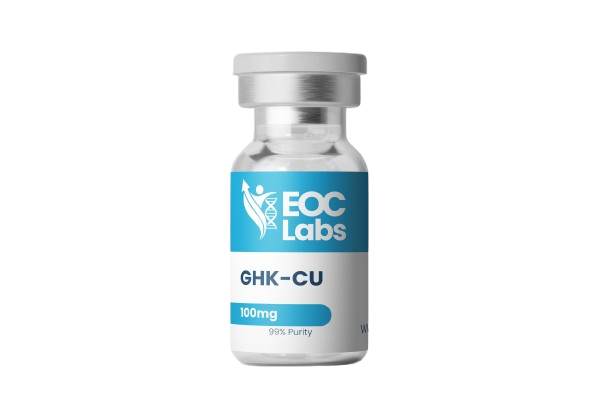
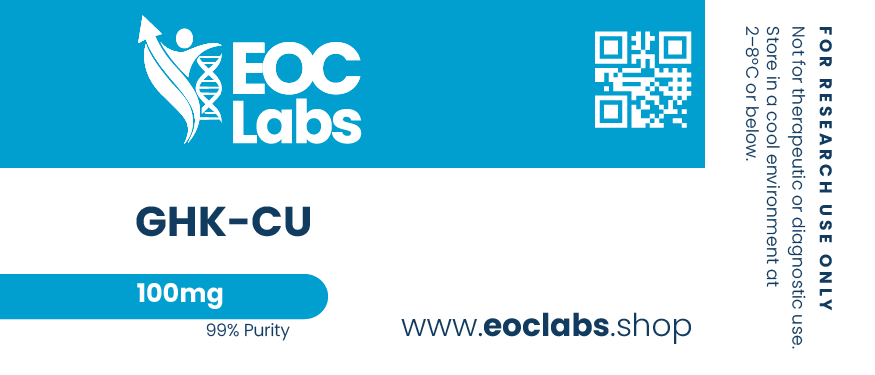
Description
DESCRIPTION
GHK‑Cu (Gly‑His‑Lys–Copper Complex) is a naturally occurring tripeptide widely studied for its roles in extracellular‑matrix modulation, dermal remodeling, antioxidant support, and cellular repair mechanisms. Research models demonstrate that GHK‑Cu may influence collagen synthesis, gene‑expression profiles, wound‑healing pathways, and microcirculatory stability. Its broad biochemical activity has made it a central peptide of interest in regenerative‑biology and cellular‑response research.
LYOPHILIZED PEPTIDES
This peptide is provided in freeze‑dried (lyophilized) form to preserve molecular stability, purity, and long‑term storage integrity. No fillers or excipients are used during lyophilization.
RESEARCH APPLICATIONS
1 — Collagen Synthesis & Extracellular‑Matrix Remodeling
GHK‑Cu has been shown in laboratory research to upregulate collagen I, III, and IV, stimulate fibronectin, and enhance ECM repair in both dermal and connective‑tissue models. Its gene‑expression influence spans more than 4,000 human genes related to tissue regeneration and cellular signaling.
(References: MDPI—https://www.mdpi.com/1422-0067/19/4/1078, Nature—https://www.nature.com/articles/s41598-017-12189-1, PubMed—https://pubmed.ncbi.nlm.nih.gov/29718284/ )
2 — Antioxidant Activity & Cellular Protection
GHK‑Cu has been studied for its ability to reduce oxidative stress, regulate inflammatory cytokines, and restore antioxidant enzyme balance in stressed tissues. Research suggests protective roles against free‑radical damage, environmental stressors, and mitochondrial dysfunction.
(References: ScienceDirect—https://www.sciencedirect.com/science/article/pii/S0022283616303225, PubMed—https://pubmed.ncbi.nlm.nih.gov/11257466/ )
3 — Wound Healing & Tissue Repair Models
Research demonstrates enhanced wound closure, angiogenesis support, keratinocyte migration, and granulation‑tissue formation with GHK‑Cu application in controlled laboratory environments. Its activity in modulating metalloproteinases and tissue‑restructuring enzymes positions it as a key model peptide in regenerative‑healing studies.
(References: Frontiers—https://www.frontiersin.org/articles/10.3389/fphar.2021.808770/full, PubMed—https://pubmed.ncbi.nlm.nih.gov/25950459/ )
SPECIFICATIONS
Property | Details
Peptide Name | GHK‑Cu (Copper Tripeptide‑1)
Amino Acid Sequence | Gly‑His‑Lys
Molecular Formula | C14H24N6O4 • Cu
Molecular Weight | ≈ 340.88 g/mol (peptide) / ≈ 403.9 g/mol (GHK‑Cu complex)
CAS Number | 89030‑95‑5
Purity | ≥ 99% (HPLC verified)
Appearance | Blue to blue‑green lyophilized powder
Solubility | Soluble in bacteriostatic/sterile water
Storage | Store dry at 2–8 °C; refrigerate after reconstitution
Usage | Laboratory research only
Research Data & References
– ECM & collagen research: https://www.mdpi.com/1422-0067/19/4/1078
– Antioxidant & anti‑inflammatory activity: https://pubmed.ncbi.nlm.nih.gov/11257466/
– Wound‑healing & tissue‑repair studies: https://pubmed.ncbi.nlm.nih.gov/25950459/
Research Disclaimer
RESEARCH USE ONLY.
This product is not intended for therapeutic or diagnostic use. EOC Labs products are sold strictly for laboratory research and analytical purposes only. All information provided by EOC Labs, including descriptions, references, and technical data, is intended solely for educational and informational purposes. Statements have not been evaluated by the U.S. Food and Drug Administration (FDA). No claims are made for any medical or consumer application. By purchasing this product, the buyer certifies that it will be handled by qualified professionals in a properly equipped laboratory and used in compliance with all applicable local, state, and federal laws and regulations.


 20% off (first time buyer sign up).
There are no reviews yet.